It was my first date with her. Although we had been friends for a while now, we thought--we could--I guess--go out. Ummm…
I wasn’t very sure why we were on a date. We never really clicked. You know, romantically. We were at best, friends (not best friends - at best, friends.). But I guess, the world has an itch to see a boy and a girl become lovers. ‘They must be a thing’. ‘Awww’. And the likes.
We were not. Fifteen minutes in we were casually chatting like the friends we had been, when I asked her, what could be, the most unusual question on a date. ‘What is Tinder?’
Hold. Pause. I know. Should have established this earlier. This is Circa 2014. When online dating apps had just started booming in our great nation.
She laughed for a considerable time before flipping out her phone. Please note: we are still on that ‘date’. She showed me three guys within three kms, who were ready to meet her. By meet, I mean date. By date, I mean hook up. By hook up I mean ding dong. Interesting. Very interesting.
Now, that’s where the date died its natural death. But I made a good friend and eventually saw a lot of hook ups and break ups on this Tinder thing. That was the only way Tinder really attracted me.
I, on the other hand, was still using love letters and pigeons. Till I eventually got married. Wait, I didn’t use pigeons. I used hawks. The messaging is faster, sharper and more effective.

Cut to 2020,
where Tinder is part of a raging competition with other dating apps like
OkCupid, Hinge and Bumble. All of them, like a variety of Mithais to a
desperate teen. Sweet, indeed.
But we don’t live in simple times anymore. When you are whispering sweet nothings in your lover’s ears. Your phone is hearing a lot of somethings. Getting ready to unload a bunch of mushy advertisements on you.
Algorithm. We are not a stranger to that anymore, right? All the big wigs in the social media space have a keen ear placed on our lives. And a close eye on the kind of things we click on throughout the day.
Dating apps are a big part of this game. But in all the love, romance, hook-ups, break-ups and emotional attyachaars, we might be overlooking something that we knew all along. Algorithm.
On their Insta page, Revolio magazine recently posted something which talks about how Tinder uses a rating algorithm to match people who are equally attractive or in the ‘same league’. This is like handing over Tinder algorithm controls to the Mean Girls (the one where Rachel McAdams acts all bitchy). Or bringing back Mark Zuckerberg’s failed concept of FaceMash. Or asking Alexis and David from Schitt’s Creek to start planning marriages like Sima Aunty. Or if the Fair and Lovely ads were well, an app.
It gets even
more evil. Every time a person with a low desirability score swipes right on
you, your score increases and it makes you more desirable. But if a person with
a low desirability score swipes left on you, you lose points. Eventually matching
with someone completely on the basis of appearance.
It’s ironic how dating apps which ventured out to break the taboo of arranged marriages, are in their own sinister way, pairing people on the basis of looks and looks alone. Reminds me of that Black Mirror episode where Bryce Dallas Howard had to put on a big, fake smile just to get some likes and be eligible in the society, resulting in a massive meltdown in the end.
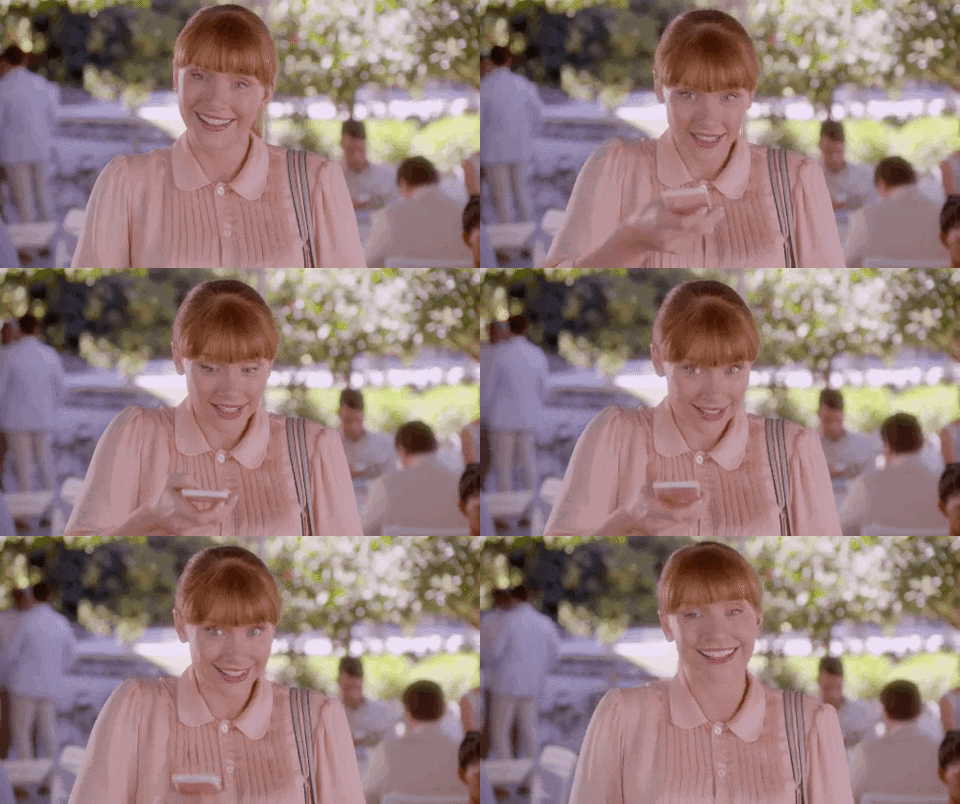
Tinder not only
has this shit going, but the desirability score is also based on what the
person liked or disliked on Facebook and Instagram. Algorithm, you back again
bro?
Algorithms can be behind many consequential decisions in your life. But that doesn’t make them full proof. They can be just as flawed as their human creators (Rachel McAdams from Mean Girls).
Scouring through some more articles, it came to my notice, I’m not the only one on this scavenger hunt for Tinder’s devious plans. Apparently, last year Tinder had stopped it’s ‘Desirability score’ or ‘Elo score’ mechanism and replaced it with another algorithm. Even after much pressing, Tinder has not released the nefarious workings of this new algorithm.
Somewhere far away, I hear Tinder laughing dastardly, Aahahhaha! Aahahaha!
In the eyes of
many, Tinder is growing to be just plain ineffective. In an age where apps like
Spotify and Apple Music can tailor your music just the way you like, it’s hard
to accept an app which tailors your matches with a really, really low success
rate.
In another press statement, while meticulously dodging questions about their new algorithm, they stated that the chances of meeting the ‘right’ person goes up with increased usage of the app.
Duh! What a marketing-y thing to say. These kind of pseudo details have left many users demoralized.
With little or
no perfect matches many (not-so-avid) users are left thinking, ‘Is it really
me?’, ‘Am I too picky?’ or ‘Am I hard to please?’.
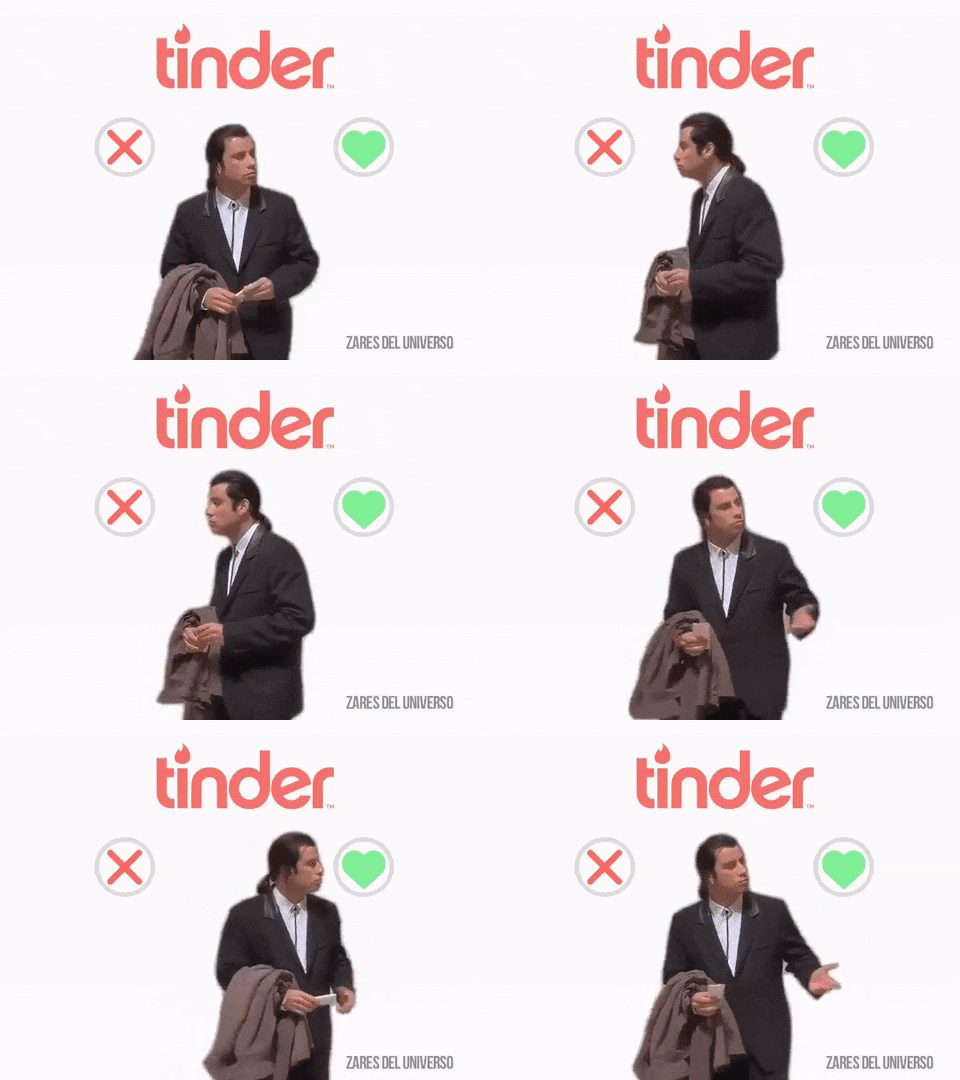
Tinder.
Mind-bender. Shape-shifter. But is it truly a game-changer?
Introducing ‘variable rate reinforcement’. For those who don’t know, it’s a gamifying mechanism used to shuffle the kind of choices you would make and present them randomly. Meaning, Tinder has got an idea of who you would match with, but to keep it fun and to keep you on the app for longer, it shuffles and throws options at you. This factor of unpredictability makes you almost addicted to it.
In a test done by Medium, they used crude programming models to produce a dating app algorithm dummy, increasing the chances of finding the ‘Perfect Match’ on Tinder to more than 60% which is far from the reality Tinder users face (maybe 10%). A dating app giant like Tinder will surely have much better resources than a blog, to make sure users find more perfect matches in a shorter time.

Picture this,
Tinder’s model changes to one that gives you a higher chance of finding your
soulmate.
Wouldn’t that
be ideal? Wouldn’t that draw more users? Would that really require tedious PR
strategies to sell it? Just leaving these questions here.

Then again, there
can be many reasons why they would go for a more complex model and make it more
meandering to get the perfect match. Maybe the fun of it all. Or maybe to get
more subscriptions as compared to one-time users. Ultimately, it does make
business sense, but at the cost of maybe many, many human emotions. Where does
all this really leave the entire universe of daters, young and old?
Well, I’ll leave you with a quote (Yes, I’ve overdone the pop fiction refs) - As Jared Harris (Valery) in Chernobyl very rightly said, ‘What is the cost of lies? It’s not that we’ll mistake them for the truth. The real danger is that if we hear enough lies, then we no longer recognize the truth at all.’